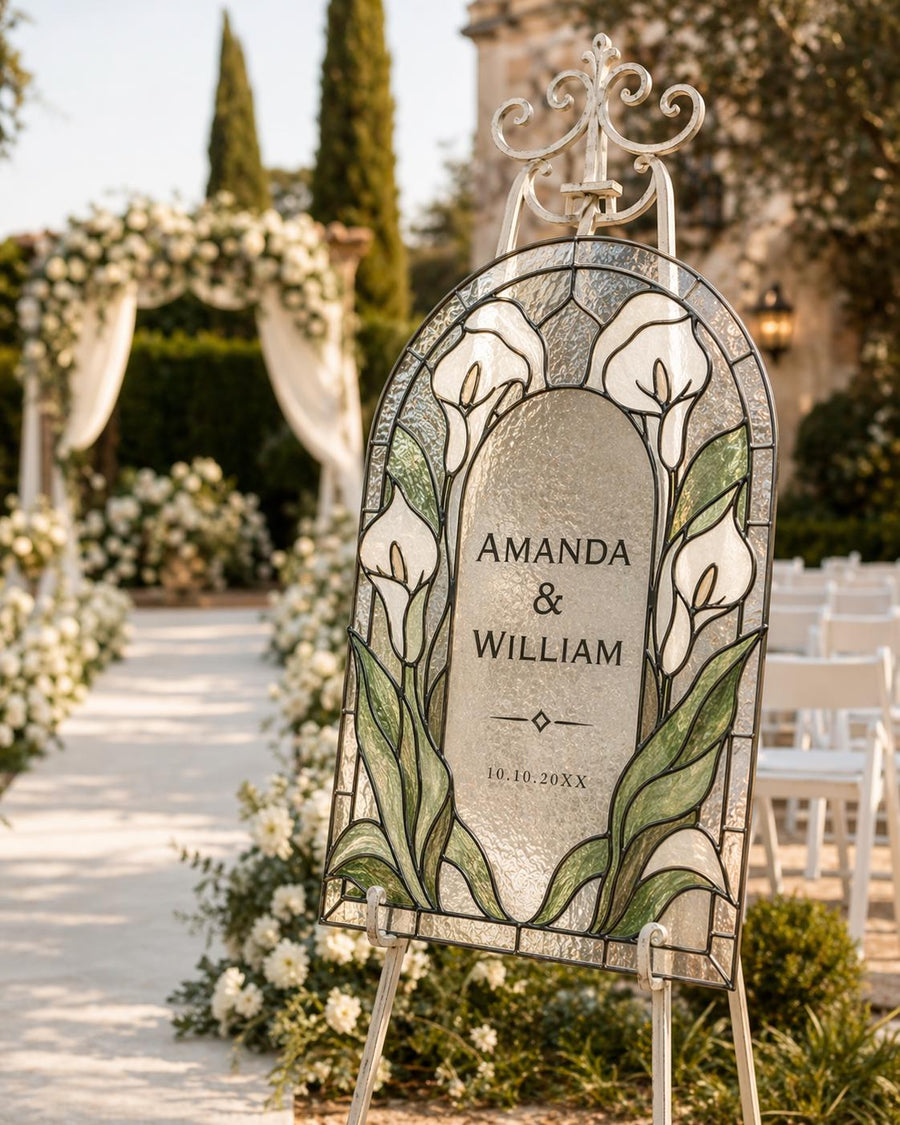
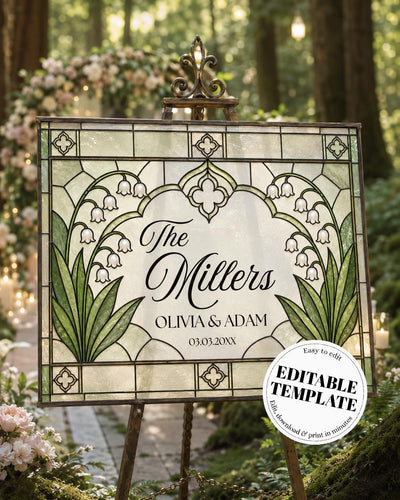
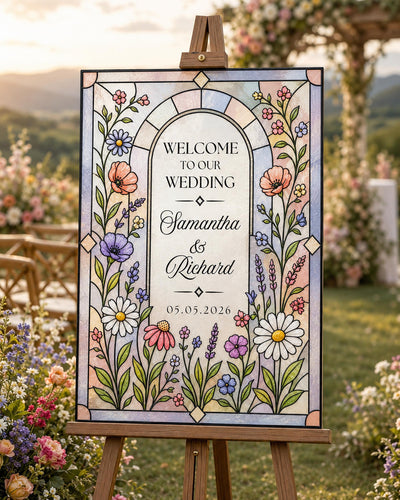
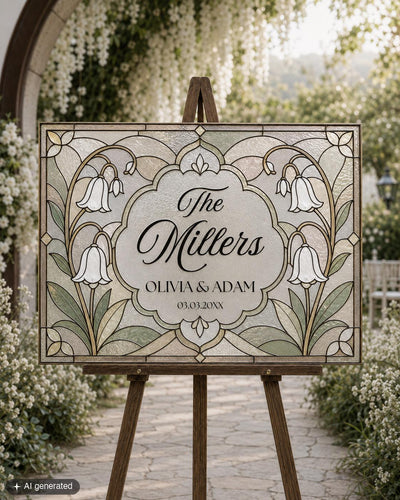
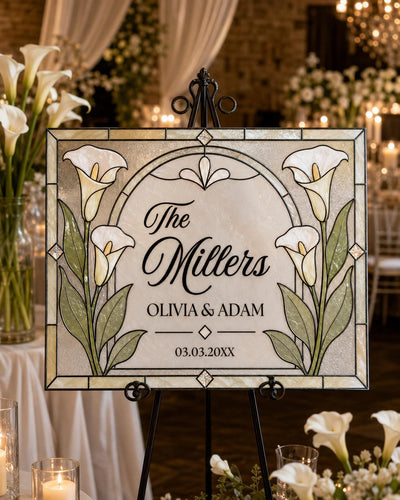
Picture your guests walking in and stopping at a faux stained glass wedding sign with your names glowing in it, like a real cathedral window catching the light. After the day it comes home with you and hangs on the wall, so you get to keep it for good. And the making of it? That's the quiet, lovely part: a few evenings with a paintbrush, watching your wedding sign come to life colour by colour.
That's what a marryful faux stained glass template gives you. You get the design, you make the piece, and you end up with something no shop-bought sign can match, because you made it yourself.

An eyecatcher on the day
A welcome sign or table numbers that guests actually stop to look at, in your colours and your names.

A keepsake for after
It doesn't get boxed up when the day ends. It hangs on your wall and keeps the memory in the room.

A project you'll enjoy
Calm, hands-on evenings in the run-up to the wedding, colouring in something that's all yours.
You don't have to be an artist to make one
This is the part people worry about, so let me say it plainly: if you can trace a line and fill it in, you can make this. The design is already drawn for you. You print it, trace the outlines, and paint between them, a bit like a grown-up colouring book on glass. Real customers say it better than I can, and quite a few of them describe themselves as "not creative" before they started.

Turned out amazing! So easy to use the template
Purchased: Last Name Wedding Sign ›

Very simple download process with insanely clear instructions!
Purchased: Last Name Wedding Sign ›

I got this design for our wedding sign and it looks incredible! Could not be happier with the results. I used a combination of gallery glass paints and acrylic glass medium with the acrylic paint color of my choice. I will say this took me a long time to complete but definitely worth it.
Purchased: Last Name Wedding Sign ›

This was such a fun project to do for my wedding! I did use a friend to help me figure out how to format and print it but overall it was very easy and came out beautiful. She also included instructions for editing in canvas and printing and sent me a message to make sure I didn’t have any questions about it which I really appreciate!
Purchased: Wildflower Faux Stained Glass Welcome Sign ›

It was so easy to trace and folllow! I just had the template printed at cvs. This was my first time making one, but with the template it made it so easy!
Purchased: Last Name Wedding Sign ›

This item was great! The file download was super easy and it had three different sizes for whatever sized image was needed. Everything was labeled so it was easy to know what was what. Great template!
Purchased: Wedding Last Name Keepsake Sign ›

Exactly what I was looking for! It was super easy to edit and download for printing.
Purchased: Last Name Wedding Sign ›

The design was perfect, very easy to trace with gallery glass. And editing it on canva was easy as well.
Purchased: Wildflower Faux Stained Glass Welcome Sign ›

Template is perfect for wedding table numbers!
Purchased: Faux Stained Glass Table Number ›
So easy to use & so much fun! I’m obsessed with making these now.
Purchased: Wedding Last Name Keepsake Sign ›
Very easy to assemble and create! One of my favorite projects to date, and I plan on making more!
Purchased: Last Name Wedding Sign ›
Seamless transaction; exactly as described! Perfect template for my wedding sign! Thank you!
Purchased: Tropical Hawaiian Wedding Last Name Sign ›
The reason it works is that nothing is left to guesswork. You follow the guide, use the supplies I recommend, and the result looks like the photos. That's the whole promise.
How it works
Here's the short version, so you know what you're getting into before you buy. The full step-by-step guide comes with your purchase.
Edit your names in Canva
Open the template in Canva (free), type in your names and date, and you're done. No design skills needed.
Print it at home or at a print shop
Use the Tile & Trace tool that comes with your download to split the design across normal paper, or send it to a print shop for one big sheet.
Trace and paint your glass
Tape the print behind clear acrylic or glass, trace the black leading, and fill in your colours. The guide walks you through every step.
Frame it and display
Stand it on an easel at the wedding, then hang it at home afterwards. That's it.
How long it takes
The template is a digital download, so you get it the moment you buy, day or night. From there you order your acrylic and paint (my list is just below), and you can start the same evening they arrive.
The painting itself is a few relaxed evenings, not a single marathon, because you let each layer dry before the next.

Make it part of the fun. A lot of brides turn this into an evening with their maid of honour and a glass of wine. Colouring in your own wedding sign is a surprisingly nice way to look forward to the day, and you end up with a story attached to the finished piece.
What I'd use to make it
Once you have your template, here are the exact supplies I'd reach for. You don't need all of it. A sheet of acrylic, a black pen and some glass paint is enough to start.
A few of these are Amazon affiliate links. If you buy through them, marryful may earn a small commission at no extra cost to you. I only link things I'd use myself.
 The colour
Gallery Glass paint
This is the paint I see recommended most, and it comes in loads of colours. You can also mix shades to make your own.
 Another paint option
Pebeo Vitrea glass paint
Another glass paint I like. The colours are strong and translucent, so it works well on its own or alongside Gallery Glass.
 For see-through parts
Clear Gallery Glass
The clear is worth having. Mix it into any colour to lighten it or make it more see-through, or use it on its own for glass-like panels.
 The leading
Black acrylic paint pen
I'd use an acrylic pen for the black outlines. It's easier to control and gives you smooth, even lines.
 For crisp lines
Precision tip bottle
Prefer Gallery Glass for the outlines? Pour it into a precision tip bottle for cleaner lines, corners and small details.
 For the detail
Paintbrushes in different sizes
Small brushes help with edges and tiny spots. Bigger ones are good for blending colours and soft gradients.
 The surface — welcome sign
Clear acrylic sheet
For a bigger sign I prefer 6 mm acrylic, it feels sturdier. Plenty of people use 3 mm too, so go with what suits your project. Match the sheet to your sign size, and remember the bigger the sign, the thicker it should be.
 The surface — table numbers
Blank acrylic table number signs
These work well for smaller table numbers, in arched or rectangular shapes. A stand is often included, and 3 mm is thick enough at this size. Look for 5×7" or 4×6" to match my templates.
The supplies are the easy part to source. The design is the piece you don't want to guess on, and that's what the template gives you: the full artwork, drawn in the stained glass style, sized and ready to trace, with your names in the middle.
Shop Faux Stained Glass TemplatesThe designs
Every design is hand-drawn in the faux stained glass style, with your last name or the couple's names set in the middle. Recolour any of them to match your florals or your season.

Wildflower meadow
Lavender, daisies and soft botanicals. The garden-wedding favourite and the easiest palette to match.
View template →
Calla lily
Tall white callas around your married name. Elegant, classic, and lovely as a keepsake.
View template →
Lily of the valley
Delicate white bells with soft green leading. Quiet, romantic, and very of the moment.
View template →
Sunflower
Warm yellow petals around your name. Recolour it rust or gold for an autumn wedding.
View template →What you get when you buy
Everything's included in one download
No extra fees, no upsells. Here's what lands in your account the moment you order.
Your editable Canva template, in more than one size
The welcome sign comes in three sizes and the table numbers in two, so you can match whatever acrylic you buy. Edit the names, date and wording in a few minutes.
Tile & Trace, the home-print tool
Turn your template into tape-together sheets you can print on any home printer, at true size. It also has a Back-of-Glass Flip that mirrors the design for a glossier, protected finish. No print shop needed.
A password-protected, step-by-step DIY guide
The full make-along guide, walking you through printing, tracing, painting and drying, with the mistakes to avoid. Your access code comes with the download.
A simple purchase and access guide
A short walkthrough for opening your template in Canva and saving your own copy, so even first-time Canva users are set up in minutes.
Bonus: the colour-mixing cheat sheet
My shortcuts for mixing any shade from a few bottles, getting see-through glass tones, and adding texture. So your colours come out exactly how you pictured them.
Match your table numbers too
Once your welcome sign is done, most brides carry the look onto the tables. The matching table numbers come in the same designs, in arched and rectangular shapes, so the whole day feels like it belongs together.
Common questions before you buy
Is this a physical sign or a template?
It's a digital template you make into a sign yourself. You buy the design, download it straight away, and paint your own piece using clear acrylic or glass. That's why it costs a fraction of a finished custom sign, and why it becomes something you made.
Do I need to be good at art?
No. The design is already drawn, so you're tracing and colouring in, not drawing from scratch. Plenty of customers say they're "not creative" and were thrilled with how theirs turned out.
What do I need to buy separately?
A clear acrylic sheet or glass frame, glass paint, and a black paint pen or liner. You'll find my full supply list with links in the "What I'd use to make it" section above, and the step-by-step guide walks you through using each one.
Can I change the names, date and colours?
Yes to all of it. You edit the wording in Canva, and you choose your own paint colours, so it matches your florals, your season, or your bridesmaid palette.
What sizes does it come in?
The welcome sign comes in three sizes and the table numbers in two, so you can match common acrylic sheet and blank sizes without resizing anything yourself.
How soon can I start?
Right away. It's an instant download, so you can edit and print the same day, then start painting as soon as your acrylic and paint arrive.
Make your own wedding sign
Pick your design, download it today, and start creating the piece you'll walk past for years. Instant access, editable in Canva, with the full DIY guide and colour cheat sheet included.
Shop Faux Stained Glass TemplatesPlease note that some images may be generated by artificial intelligence for illustrative purposes only.